The Case in Brief
The largest liberation effort in the Middle East today is being carried out by the one party almost nobody is willing to credit with it. Israel’s war against Hamas is usually described as a matter of security, sometimes as a matter of revenge, and, in the more excitable corners of the internet, as something far worse. It is rarely described as what it also is: the removal of an armed tyranny from two million people who never chose it and have never been permitted to un-choose it. Israel is defending itself, certainly. It is also, whether it gets the thanks or not, freeing Gaza’s civilians from the people who have ruled them at gunpoint for nearly two decades.
This is what liberation would actually look like. Not a parade, but the ordinary freedoms of a place where you can chant against your rulers without a visit from masked men, where aid money buys cement for homes rather than tunnels, and where a hospital is only a hospital.
That is an awkward sentence to write in polite company, which is perhaps why so few people write it. The war is narrated as a contest between two parties, Israel and “the Palestinians,” with Hamas cast as a regrettable intermediary, like a landlord everyone complains about but nobody thinks to evict. The landlord is the problem. The tenants are the ones who stand to gain most from his departure.
What Hamas Is
Hamas was founded in December 1987, at the start of the First Intifada, by the cleric Ahmed Yassin and a few associates, as an offshoot of the Muslim Brotherhood. Its 1988 charter called for an Islamic state across the whole of historic Palestine. A 2017 revision polished the prose without getting round to recognizing Israel’s right to exist, which is a bit like a burglar updating his business cards. America, the European Union, Britain, and a long list of others designate it a terrorist organization. This is less an accusation than a summary of its CV.
The CV is long. Hamas carried out its first suicide bombing in April 1993 and spent the Oslo years trying to blow the peace process apart, bus by bus. In June 2001 one of its bombers killed twenty-one people, mostly teenagers, outside a Tel Aviv discotheque. In March 2002 another killed thirty people at a Passover seder in Netanya. Rockets began flying in 2001 and have rarely paused since. Then came October 7, 2023, when Hamas fighters killed some 1,200 people in southern Israel, most of them civilians, and carried roughly 250 hostages back into Gaza. Thirty-odd years of this is not a “cycle of violence.” It is a business model, and Gaza’s own people have been its first and longest-suffering customers.
How a Movement Becomes a Regime
It is often said that Hamas was elected. It was, once. In January 2006 it won a large majority in the Palestinian legislature, to the evident surprise of Washington and Jerusalem. What came next tends to be left out of the retelling.
Hamas rejected the international conditions for recognition, a unity government came and went, and by June 2007 the two main factions were shooting at each other in the streets. Human Rights Watch documented that in eight days Hamas seized every security installation and the main government offices in Gaza. Detainees were tortured and beaten, Fatah rallies were broken up by force, and the courts more or less stopped working. Fatah officials were jailed, killed, or chased out. Hamas’s defenders say it was getting its retaliation in first against a Fatah plot, and there is evidence Washington was arming Fatah for just that sort of thing. It hardly matters. A party that wins a vote and then settles the question of who governs with rifles has told you which of the two it believes in.
There has been no election in Gaza since. (There has been none in the West Bank either, which says little for the alternatives and nothing at all for Hamas.) This is the plainest sense in which ending Hamas’s rule is a liberation: Gazans did not get to keep the one vote they cast. They got a regime instead.
The Patrons
Tyranny on this scale is not cheap, and Hamas has never had to pay for it alone. Its senior backer for most of the past twenty years has been Iran, which by the State Department’s reckoning sends around $100 million a year to Palestinian militant groups, Hamas chief among them. Tehran turned off the tap in 2012, reportedly at $23 million a month, when Hamas declined to cheer for Bashar al-Assad in Syria, and turned it back on in 2017. One Israeli estimate put Iran’s support at $350 million a year by 2023.
Qatar has housed Hamas’s political leadership for years, and its emir pledged more than $400 million in 2012 alone. Turkey hosts senior Hamas figures, declines to call the group terrorist, and has been named by Israeli intelligence as the base of an Iranian-run money-changing network that moved hundreds of millions of dollars into Gaza. That one of these patrons is a major non-NATO ally of the United States and another is a full member of NATO would be satire if it were not simply the arrangement.
The money did build things in Gaza. It built tunnels, rockets, and a payroll of fighters. What it did not build was much in the way of freedom for the people paying the price for it. Cutting that pipeline, which Israel’s campaign has done more to accomplish than a decade of Western diplomacy, is not only good for Israel’s security. It is the end of a subsidy for the oppression of Gaza’s own civilians.
The Shield
The defining military fact about Hamas is that it fights from behind the people it rules. This is no longer merely Israel’s claim. It is on the record from sources with little affection for Israel.
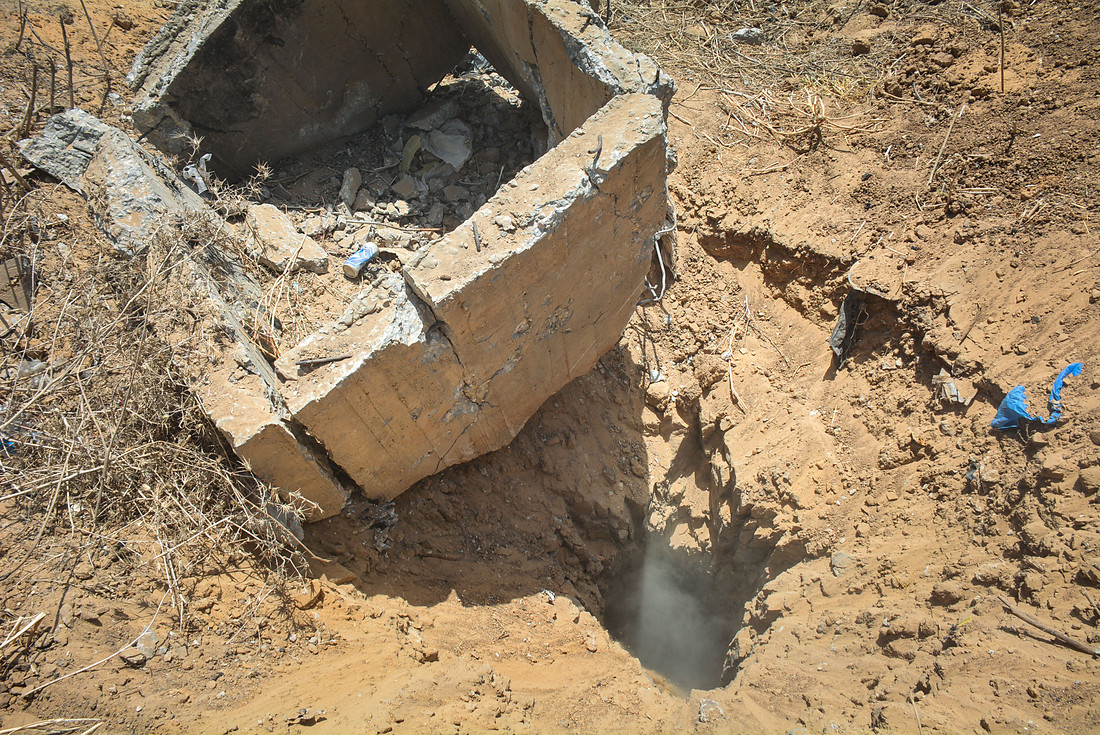
In 2017 UNRWA, the UN agency for Palestinian refugees, found a tunnel under two of its boys’ schools in the Maghazi camp and protested to Hamas. In 2021 it found another cavity seven and a half meters beneath a school and condemned the armed groups for putting pupils and staff at risk. In January 2024 American intelligence agencies said they were confident that Hamas and Islamic Jihad had used Gaza’s largest hospital, al-Shifa, and the tunnels under it to run command operations, store weapons, and hold hostages. The evidence released fell short of proving Israel’s grander claim that Shifa was the beating heart of the whole enterprise. Still, “merely a command post with some hostages” is a thin defense for a hospital.
The law is clearer than the commentary. Using civilians as shields is forbidden outright, and a hospital used to attack the enemy loses its protection once a warning has been given and ignored. The law does not let the attacker off lightly; Israel remains bound by the duties of distinction, proportionality, and precaution, and should be held to them. But nor does the law accept the comfortable fiction that the side which wages war from a schoolyard bears no responsibility for what happens in it. A state shelled from beneath a hospital can either absorb the shelling forever or act and risk exactly the casualties its enemy has arranged. Hamas has built its strategy on the wager that democracies will choose the first, and that when they choose the second, the world will blame them for the bodies.
Here, too, the liberation argument holds. A population used as sandbags is not a population that is free. Every tunnel under a school is a statement about how much Hamas values the children above it, and the answer is: about as much as the concrete.
The People behind the Shield
Which brings us to the heart of the matter. If Hamas is a threat to Israel, it has been for nearly two decades a far more intimate threat to Gaza.
Gazans have tried, at real personal risk, to say so. They protested Hamas rule in 2011 and 2012, again in 2019, and again in the summer of 2023, and were met with arrests. In March 2025 an anti-war march in Beit Lahia turned into something Gaza had not seen on that scale: thousands of people in the streets chanting “Hamas out” and calling its fighters terrorists. The protests spread to Jabalia and Khan Younis, then faded under the sort of pressure that included intimidating the journalists trying to cover them. When the October 2025 ceasefire took hold, Hamas’s first act was not to rebuild a single house. It redeployed some 7,000 fighters to reassert control, rounded up suspected collaborators, and picked a fight with a rival clan. Liberators, one notes, do not usually begin peacetime by arresting their own public.
This is what liberation would actually look like. Not a parade, but the ordinary freedoms of a place where you can chant against your rulers without a visit from masked men, where aid money buys cement for homes rather than tunnels, and where a hospital is only a hospital. None of that is possible while an armed movement answerable to Tehran and Doha keeps a monopoly on force. Removing Hamas is not the obstacle to a decent future for Gaza. It is the precondition. Every serious plan for the territory, including the American-brokered one now limping along, assumes as much. Hamas’s civil administration formally stepped down in July of this year, and a deal to disarm the militant factions followed at the end of that month, conditional on reconstruction and Israeli withdrawal. Whether it holds is another question. That it was needed at all is the point.
The Word Everyone Reaches For
No conversation about this war gets very far before someone says “genocide.” The charge deserves to be taken seriously, partly because serious people make it and partly because the word is too important to spend carelessly.
The case against Israel is not trivial. In December 2023 South Africa took Israel to the International Court of Justice under the Genocide Convention, and in January 2024 the court found the claim plausible enough to order provisional measures, including steps to prevent incitement and to let aid in. In September 2025 a UN commission of inquiry, which does not speak for the UN itself, concluded that Israel had committed genocide and accused Benjamin Netanyahu, Isaac Herzog, and Yoav Gallant of inciting it. The International Criminal Court has issued arrest warrants for Mr. Netanyahu and Mr. Gallant for war crimes and crimes against humanity, among them the use of starvation as a method of war. By August 2025, famine had been confirmed in Gaza City.
Note what the warrants say, and what they do not. Genocide is a crime of intent: the deliberate attempt to destroy a people, in whole or in part, as such. Killing a great many people, even recklessly, even criminally, is a different offense, which is why the prosecutors in The Hague charged war crimes rather than genocide. The World Court, for its part, has yet to rule on the merits at all. Israel filed its defense in March of this year; South Africa has until November 2027 to reply, and Israel until May 2029 to answer that. A verdict should arrive, at this rate, somewhere around the next war.
The contrast is worth drawing. Armies bent on extermination do not, as a rule, drop leaflets telling their targets where to flee, or sign ceasefires that let food in. The party in this war whose founding charter and whose October morning come closest to an intent to destroy a people as such is not Israel. It is Hamas.
None of which acquits Israel, and it should not be read that way. My own view is plain. Israel has a sovereign right to defend itself, and some of what it has done goes well beyond defense. Starving a population is not self-defense. Nor is the steady drip of lethal strikes after a ceasefire has been signed, nor ministers who talk about Gaza’s people as though they were a demolition problem. Some of these acts may well be crimes, and if they are, the people who ordered them should answer for them in a court. Self-defense is a licence, not a blank cheque. But a crime is not a genocide, and a word stretched to cover everything is left with nothing to describe the next time it is truly needed.
A liberator who commits crimes along the way is still a liberator, but a compromised one. The remedy is accountability, not abandoning the people waiting to be liberated.
The Ledger
None of this makes the cost anything less than appalling. By late September the Gaza Health Ministry, which is run by Hamas and whose figures should be read with care but not waved away, reported nearly 74,000 Palestinians killed. Israel has lost more than 2,000 of its own. More than a hundred humanitarian groups warned this month that the ceasefire exists largely on paper, with over 1,400 people killed since it began and aid still choked. Israel’s control has crept from about half of the Strip to around 65 percent. A liberation that kills the liberated must answer to the hardest possible standard, and the case made here is only as strong as Israel’s conduct is scrupulous. Israel’s friends should insist on that standard rather than wave it away; a rescue that ends in permanent occupation is not a rescue.
But the moral arithmetic of war cannot be settled by body counts alone. If it could, the side most willing to sacrifice its own civilians would win every argument, and Hamas understood that long before its critics did. The question is not only who is dying, but who arranged for them to be standing where the bombs fall.
The Unthanked Liberator
Strip away the noise and the proposition is simple. Hamas took Gaza by force, held it by fear, financed itself through foreign despots, and spent its people’s lives as ammunition. Ending that rule protects Israel. It also frees the Palestinians of Gaza from the longest-running and least-discussed occupation in their recent history: their own government’s.
Ask Gazans today whom they blame for their condition, and Hamas, one reporter found this month, is not the first name they give. Liberators are seldom thanked by the liberated, least of all while the rubble is still warm. Then again, nobody in Gaza has been asked their opinion of anything since 2006.