A Modest Proposal Regarding Ms Omar
Let me say something I never expected to write: I would like to see Ilhan Omar deported.
Not because she deserves it. Not because I dislike her, her politics or her hijab, which seems to occupy the president rather more than it occupies her. I say it because nothing else seems capable of waking up the people who could actually stop what is being done to migrants, and because the administration appears determined to try it anyway.
For two years the fight against mass deportation has been carried mostly by people with no lawyers, no platform and no vote. A detainee cannot call a press conference. A day labourer cannot subpoena an agency.
The facts, such as they are. The Wall Street Journal reported this month that the federal investigation into Ms Omar is aimed at stripping her citizenship and eventually removing her. Federal agents have searched her Washington home. The president has said she could face jail or deportation. His border czar, Tom Homan, has said denaturalization is possible if she lied during the process. Her office calls the whole affair politically motivated and without basis in law. No court has found against her, and as of this writing no charges have been reported.
Here is the grim logic. For two years the fight against mass deportation has been carried mostly by people with no lawyers, no platform and no vote. A detainee cannot call a press conference. A day labourer cannot subpoena an agency. Remove a sitting member of Congress, someone with committee seats, a press office and several hundred thousand constituents, and every one of her 434 colleagues must suddenly ask who is next. Senators would rediscover due process. Governors, judges and chief executives who have found the subject awkward would find silence impossible. The fight would stop being about whether migrants deserve sympathy and start being about whether citizenship means anything at all. That is a fight the powerful cannot sit out, because it is about them.
I hope it never comes to that. But to understand why it might take a congresswoman on a plane to make Washington care, you need to understand who the migrants are, what they have survived, and how the country they were running towards changed its mind.
Not All Mexicans, and Fewer Each Year
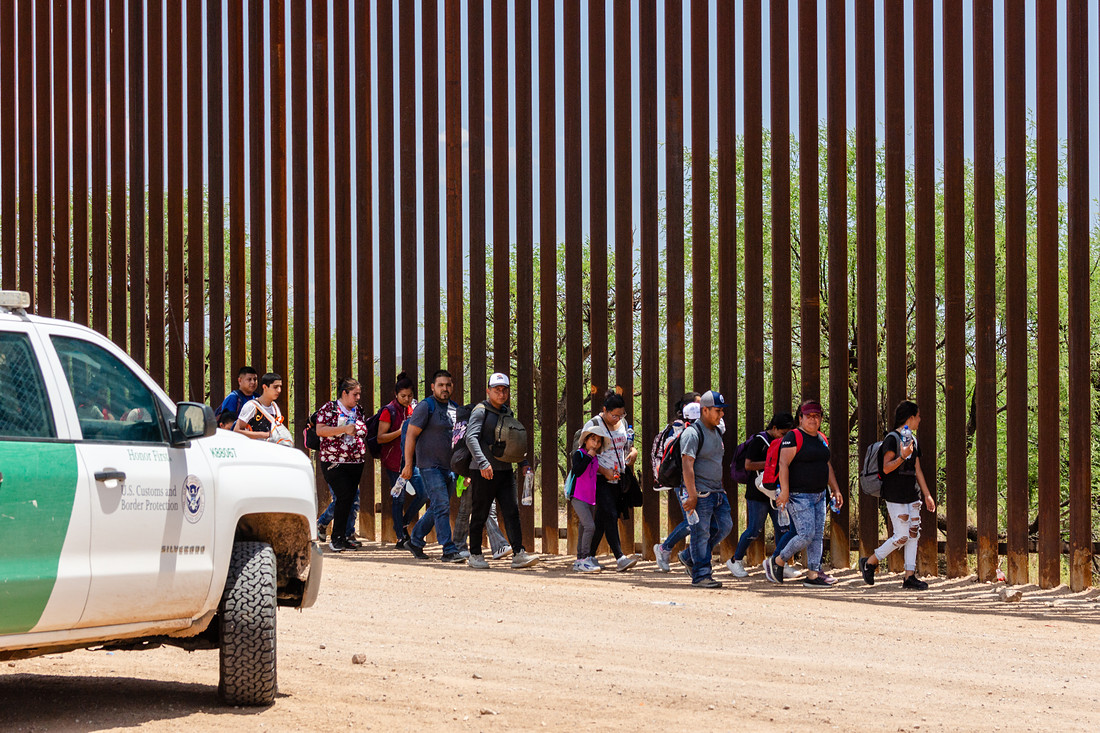
Ask a certain sort of American to picture a migrant and he will picture a young Mexican man. He is about two decades out of date.
In fiscal 2000, Mexicans made up 98% of the people the Border Patrol caught at the southwest border, according to the Pew Research Center. By 2016, non-Mexicans outnumbered them for the first time. By 2018, they made up more than six in ten. Meanwhile the number of unauthorized Mexican immigrants living in America actually fell, by about 2 million in the decade to 2017.
The new arrivals came from everywhere. Between 2021 and 2023, the biggest increases in border encounters were Venezuelans, Colombians and a large category CBP simply labels “other countries.” Chinese encounters rose more than fifty-fold. By fiscal 2024, the top ten nationalities included Venezuela, Guatemala, Cuba, Honduras, Colombia, Ecuador, Haiti, El Salvador and China alongside Mexico. Further south, people from Afghanistan, India and a dozen African countries were turning up in the Panamanian jungle.
Mexico still sends many, and its share rose again as other routes were choked off. But the border is no longer a story about one neighbour. It is a story about a hemisphere, and increasingly the world.
What They Are Running From
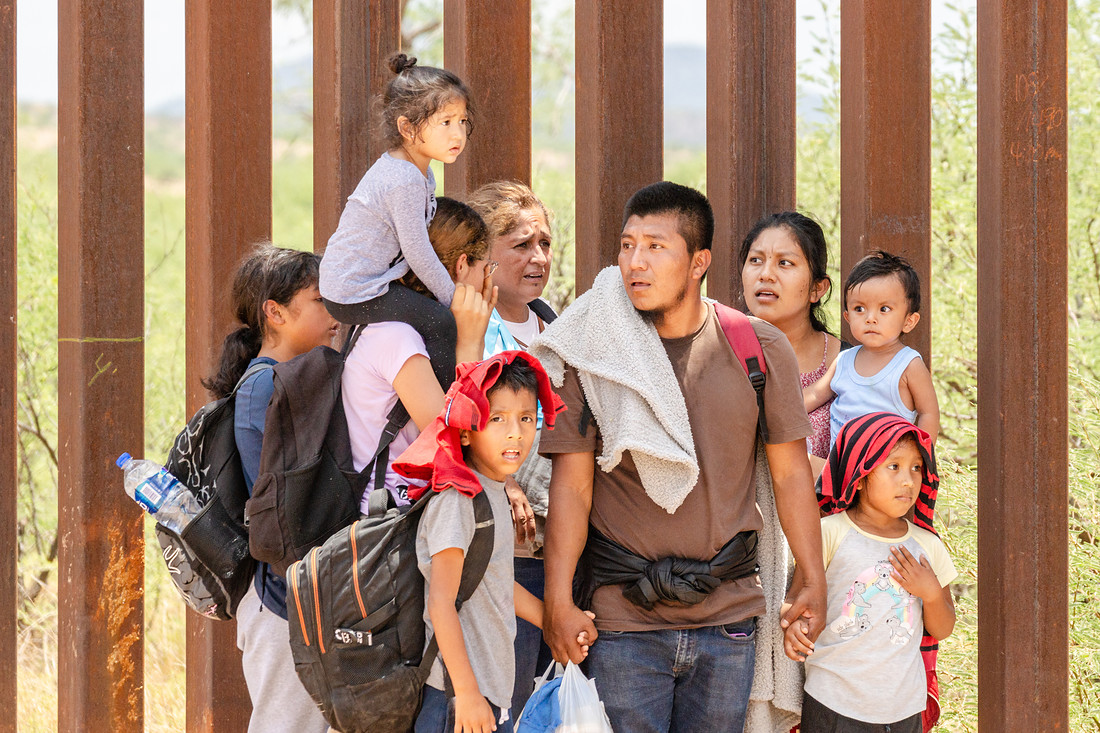
Nobody leaves home with a toddler and a plastic bag because the weather is nicer in Phoenix. The reasons are specific, and grim.
Mexico. In a 2022 IOM survey cited by the Council on Foreign Relations, nine in ten Mexican migrants said they left because of violence, extortion or organized crime, much of it concentrated in Guerrero, Chiapas and Oaxaca.
Guatemala, Honduras and El Salvador. Gangs tax small businesses, recruit children and kill those who refuse. In Guatemala’s “dry corridor,” years of failed harvests have left subsistence farmers choosing between hunger and the road.
Venezuela. Hyperinflation, food shortages and an authoritarian government whose security forces have been accused of serious abuses. Nearly 8 million Venezuelans have left since 2014, roughly a quarter of the country. Most cite economic collapse; many cite fear.
Cuba. A shrinking economy, shortages of food and medicine, and a state that punishes dissent.
Ecuador. Once among the region’s calmer places, it posted Latin America’s highest murder rate in 2023, driven by drug gangs.
Haiti. Armed gangs control much of the capital, the state has largely ceased to function, and a series of disasters has stripped away whatever cushion families once had.
Colombia. A long internal conflict that never fully ended, plus insecurity and slow growth.
These are not people seeking luxury. They are seeking the things most Americans never think about: a front door that locks, a wage that buys dinner, a school that is open, a street their children can walk down. If your house were on fire, you would run too.
Why America, of All Places
There are closer places to run, and many do. Colombia has taken in millions of Venezuelans; so have Peru, Brazil and Chile. Most of the world’s displaced people never leave their own region.
But America remains the magnet for reasons that are flattering to it. Its economy is the largest in the world and keeps generating jobs that its ageing native workforce does not fill. It has courts that, for all their delays, still sometimes rule against the government. It has diaspora communities in nearly every city, which means a cousin with a sofa and a lead on work. And it has a reputation, built over two centuries and printed on the base of a statue, as the place that takes people in. Reputations outlive the policies that earned them, which is part of the tragedy that follows.
The Road, and the People It Swallows

For many, the journey begins in South America and runs through the Darién Gap, the roadless strip of jungle and mountain joining Colombia to Panama. A decade ago only a few thousand people a year attempted it. In 2023, more than half a million did, according to Panamanian figures reported by the Migration Policy Institute, most of them Venezuelans, along with Ecuadorians, Haitians and growing numbers of Chinese, Indians and Afghans.
The crossing on foot takes four to ten days. Migrants climb steep, muddy slopes, ford rivers that rise without warning, and run out of food and clean water within days. Broken bones are routine. Drowning is common. Bandits rob them, and Doctors Without Borders treated more than 200 victims of sexual violence there in just the first part of 2023. There is no phone signal, so there is no calling for help.
Then comes the long haul north through Central America and Mexico, by bus, on foot or on the roofs of freight trains, past cartels that kidnap migrants for ransom and officials who sometimes do the same for less. Journeys stretch from weeks to many months. Families spend their savings, then borrow more, paying smugglers whose business model depends on their desperation.
Some never arrive. The International Organization for Migration counted at least 1,233 deaths on migration routes through the Americas in 2024, its deadliest year on record: 523 at the US-Mexico border, 174 in the Darién Gap, and 187 at sea between the Caribbean and American shores. The IOM itself says the true number is likely far higher, because the desert and the jungle keep their own counsel, and most of the dead are never named. The US-Mexico border has been described by the IOM as the deadliest land migration route in the world.
Those deaths happen in the Sonoran Desert, not far from where I write. People die of heat in the same hills that suburban Arizonans hike for fun on cool mornings.
Two Parties, One Revolving Door
It is tempting to tell this as a morality play with one villain. The record is messier, and more instructive.
In 1986 Ronald Reagan, a Republican, signed the Immigration Reform and Control Act, which legalized about 2.7 million people while also penalizing employers who hired undocumented workers. George W. Bush spent much of his second term pushing a comprehensive reform with a path to legal status, and lost to his own party.
Democrats have hardly been pacifists. Barack Obama’s administration carried out more than 432,000 removals in fiscal 2013, a record that earned him the title “deporter in chief” from immigrant advocates. Joe Biden, after opening his term with promises of a humane system, signed an order in June 2024 that effectively closed off asylum at the southern border whenever crossings averaged above 2,500 a day.
In early 2024, a bipartisan group of senators led by Republican James Lankford negotiated the toughest border bill in decades: more agents, faster asylum decisions, and emergency powers to restrict crossings during surges. Donald Trump, then a candidate, came out against it and urged allies to vote it down. They did, twice. The bill failed 43-50 in May 2024, well short of the 60 votes needed. Whatever one thinks of its contents, it showed that a deal on regulation was within reach, and that it was killed less for what it did than for whom it might help politically.
The pattern across both parties has been regulation with a hard edge: manage the flow, deter the reckless, process the rest. Until recently, nobody in power proposed that the flow should simply stop.
The Helping Years
Alongside the enforcement, there was a parallel effort to offer people a legal door instead of a desert. The Biden administration created a parole programme for Cubans, Haitians, Nicaraguans and Venezuelans that let people with an American sponsor fly in legally rather than walk through the Darién. It expanded the CBP One app so asylum seekers could book appointments at ports of entry rather than wading the Rio Grande. It extended Temporary Protected Status to hundreds of thousands of Venezuelans and Haitians whose countries were unsafe to return to. And it set the refugee ceiling at 125,000 for fiscal 2025.
These programmes were imperfect, sometimes chaotic, and not always popular. But they reflected an idea with deep American roots: that if people are going to come anyway, it is better, safer and more orderly to give them a legal way to do it than to make the smugglers rich.
The Shutting of the Door
The second Trump administration has taken a different view, and pursued it with vigour.
Refugee admissions for fiscal 2026 were capped at 7,500, the lowest in the programme’s history, and most of the slots were reserved for white South Africans, whose government denies they face persecution. The parole programme for Cubans, Haitians, Nicaraguans and Venezuelans was terminated, and in May 2025 the Supreme Court allowed that termination to proceed while litigation continued. Temporary Protected Status for Venezuelans and Haitians was cut back or ended.
Then came the deportations. By the end of July 2026, ICE and CBP had deported about 980,000 people, according to the Migration Policy Institute. About eight in ten had no criminal conviction. Among those who had lived in America for at least two years, seven in ten had none. These are not, by and large, the “worst of the worst.” They are neighbours, coworkers and parents.
Border encounters, meanwhile, collapsed to their lowest level since 1970, a fact the administration cites as proof that its approach works and its critics cite as proof that people fleeing danger have simply been left to it.
The human cost has spilled beyond migrants. About 60,000 people are now held in immigration detention, and 29 died in ICE custody in the first half of fiscal 2026 alone, already a record, according to government data reported by NPR. Two American citizens, Renee Good and Alex Pretti, were killed by federal immigration agents in Minneapolis in January. US citizens in Arizona and elsewhere have reported being detained.
And now, reportedly, a sitting member of Congress.
A Nation of Immigrants, With Footnotes
Defenders of migrants like to say America was founded by immigrants. It was, though the phrase skips some awkward passengers. The people already here were not consulted. Millions of Africans came in chains, not by choice. And the founders’ first naturalization law, in 1790, limited citizenship to “free white persons.”
Still, the founding generation did express an ideal, even when it fell short of it. George Washington wrote in 1783 that America should be open to “the oppressed and persecuted of all Nations and Religions.” That line was aspiration rather than policy, but aspirations matter. They are the standard a nation sets for itself, and the one it can be held to.
Nor has the country ever lived up to it consistently. The Know-Nothings of the 1850s raged against Irish Catholics. The Chinese Exclusion Act of 1882 barred an entire nationality. The quota laws of 1924 were designed to keep out Italians, Jews and Eastern Europeans. In 1939, America turned away the St. Louis, a ship of Jewish refugees from Nazi Germany; many of its passengers later died in the Holocaust.
So the honest story is not that America once welcomed everyone and has now turned cruel. It is that America has always fought with itself over this question, and that the welcoming side has usually won in the end, and been proud of it afterwards. Nobody today defends the Chinese Exclusion Act. Few will defend this era, either, once it is over.
The Lady and Her Poem
The Statue of Liberty was a gift from France, meant to celebrate liberty and the friendship between two republics, not immigration. It was Emma Lazarus who gave it a different job.
In 1883, Lazarus, a New York poet from a long-established Jewish family, was asked to write a sonnet for an auction to raise money for the statue’s pedestal. She had been volunteering with Jewish refugees fleeing pogroms in Russia, many of them held on Ward’s Island in miserable conditions. What she saw shaped what she wrote. Her poem, “The New Colossus,” recast the statue as a “Mother of Exiles” and gave her these words:
“Give me your tired, your poor, Your huddled masses yearning to breathe free, The wretched refuse of your teeming shore. Send these, the homeless, tempest-tost to me, I lift my lamp beside the golden door!”
The poem was largely forgotten after her death. In 1903 a friend, Georgina Schuyler, campaigned to have it cast in bronze and mounted inside the pedestal. Over the following decades, as ships full of Italians, Poles, Greeks and Jews steamed past the statue into New York harbour, the poem became the statue’s meaning.
Note what it asks for. Not the skilled, the vetted or the wealthy. The tired, the poor, the homeless, the wretched. It is an invitation to precisely the people America now spends billions keeping out.
What the Scriptures Say, for Those Who Quote Them
Many of the loudest supporters of mass deportation describe themselves as Christian patriots. It is worth taking them at their word, and reading what their book says.
The Hebrew scriptures are blunt. Leviticus 19 commands that the stranger who lives among you be treated as native-born and loved as yourself, “for you were strangers in the land of Egypt.” The theme recurs again and again: the widow, the orphan and the foreigner are the three groups God singles out for protection.
Jesus was more direct still. In Matthew 25, he describes the final judgment, in which people are separated by one test: did they feed the hungry, give drink to the thirsty, clothe the naked, care for the sick and visit the prisoner, and did they “welcome the stranger”? Those who did, he says, did it to him. Those who did not are sent away. Notably, the passage contains no exemption for strangers who arrived without paperwork.
Paul, in his letter to the Romans, tells believers to “practice hospitality.” The letter to the Hebrews, traditionally though not certainly attributed to Paul, urges Christians not to neglect showing hospitality to strangers, “for thereby some have entertained angels unawares.” The Greek word used, philoxenia, literally means love of the stranger. Its opposite is the root of a more familiar word: xenophobia.
Even the soldiers get a say. The motto of the US Army Special Forces is “De Oppresso Liber,” usually translated as “to free the oppressed.” It is an odd country that engraves that on its green berets and then cannot find room for the oppressed when they show up on their own.
The Hospitality Paradox
Anyone who has travelled in the Muslim world knows what comes next, because they have been on the receiving end of it.
Hospitality in Islam is not a pleasantry. It is a religious duty. The Koran repeatedly commands kindness to the wayfarer, the traveller far from home. A well-known saying attributed to the Prophet Muhammad holds that whoever believes in God and the Last Day should honour his guest. Across the Arab world, Turkey, Iran and Central Asia, travellers routinely find themselves fed, housed and refused the chance to pay by strangers with far less than they have. In the Bedouin tradition, a guest may be sheltered for days before anyone thinks to ask his business.
And so we arrive at an irony that would be funny if it were not so expensive. Some of the Americans most fearful of Islam, many of whom have never left the country and have therefore never sat at a Muslim family’s table, are the ones most determined to abandon the very virtue that Islam and their own Bible share. The faith they fear practises the hospitality their scripture commands. They have it the wrong way round, and they do not know it, because they have never been anywhere to find out.
That is not true of all Christians, or all conservatives, and it would be unfair to suggest it was. Many churches are among the most dogged defenders of migrants in the country, running shelters and legal clinics while their own congregations argue about it. But it is true of a loud and powerful slice of American public life that has fused faith, flag and fear into a single identity, and kept the fear while losing the faith.
Where We Have Been, Where We Are, Where We Need to Go
Where we have been: a country that argued about immigration constantly, sometimes shamefully, but that generally believed a person’s willingness to work and build a life here mattered more than where they were born. Reagan, in his farewell address, described his shining city on a hill as having doors open to anyone with the will and heart to get here. That was a Republican president, not a radical.
Where we are: a country where the president calls a congresswoman and her friends “garbage,” where refugee slots go mostly to white South Africans, where deaths in detention set records, where American citizens are killed at protests and a congresswoman’s citizenship is under review. The language has shifted from managing migration to purging migrants. That is not a policy disagreement. It is a change in what the country believes about who counts.
Where we need to go is not to open borders. No serious country has them, and pretending otherwise hands the argument to the other side. It is back to a system that is firm, fair and humane all at once:
Legal doors that actually open, so that people do not have to choose between a smuggler and a jungle. Sponsorship and parole programmes like those just dismantled were built to do exactly this.
Enough immigration judges and asylum officers to decide cases in months rather than years, so that those with real claims are protected quickly and those without are returned quickly, without camps.
Serious investment in the conditions people flee, from anti-gang policing to drought-resistant farming, because the cheapest refugee to help is the one who never has to leave.
Enforcement aimed at genuine threats, rather than at gardeners, nannies and parents dropping children at school.
And a public language that treats migrants as people, because the policies follow the language. They always have.
Which Road Leads Back
Readers will want to know which party offers the best route back. Honesty requires an unsatisfying answer before a clearer one.
Neither party has clean hands. Democrats under Obama deported people at record rates, and under Biden ended up restricting asylum in ways their own base called cruel. Republicans under Reagan and Bush, by contrast, were once the party of amnesty and comprehensive reform.
But parties are judged by what they do now, not what they did then. Today, the Republican Party is led by a president whose administration has cut refugee admissions to a record low, ended humanitarian parole, deported nearly a million people, most without criminal records, and is reportedly seeking to denaturalize an elected opponent. Its congressional majority killed the most serious bipartisan border bill in a generation at its leader’s request. Whatever its members privately believe, the party as an institution is the engine of the current policy.
The Democratic Party, for all its timidity and its record, is the only major party currently defending legal pathways, refugee resettlement, TPS and due process for migrants, and the one whose members are on the receiving end of the denaturalization threat. If the goal is a return to a welcoming but orderly system, the electoral arithmetic points mostly in one direction.
Mostly, but not only. The most effective defenders of migrants have often been outside party politics altogether: churches, synagogues and mosques running shelters; lawyers working for nothing; business owners who need workers; mayors and sheriffs who refuse to treat their neighbours as quarry. And the country will not get back to its better self without some Republicans, the heirs of Reagan and Bush, finding their voices again. Reform that passes on party lines will be undone the next time power changes hands. Reform that passes with both is the kind that lasts.
So the practical answer is: vote for the party that is currently defending migrants, and press it hard to be braver; and support every Republican willing to break ranks, because the long road back needs both.
The Case Against This Column
Fairness demands I argue with myself, and there is plenty to argue with.
Wishing deportation on a real person as a tactic is ugly, even when the harm is coming anyway. Ms Omar has children and a life, and she is not a chess piece. Shocks can also normalize: if a congresswoman can be removed and the republic keeps humming, the lesson may be that resistance is pointless. And the law is not on the government’s side; a citizen cannot simply be deported, and denaturalization requires a federal court to find fraud, a high bar rarely cleared.
Supporters of the current policy would make a serious case that deserves an answer rather than a sneer. They would argue that a nation has the right and duty to decide who enters, and that the surge of 2021 to 2023, with more than 2 million border encounters in fiscal 2022 alone, overwhelmed cities from New York to Chicago and strained schools, shelters and hospitals. They would note that smuggling cartels profit from every crossing, so a closed border starves them. They would point out that border crossings are now at their lowest level in more than half a century, and that fewer crossings mean fewer deaths in the desert. They would say that low-wage American workers bear the brunt of competition from undocumented labour. And they would say, with some justification, that voters in 2024 chose this policy at the ballot box, and that democracy means accepting that.
Many who hold these views are not racists or xenophobes. They are people worried about order, wages and the rule of law, and lumping them together with the bigots is both unfair and a reliable way to lose elections. The honest disagreement is real: how many people, by what process, at what speed, and at what cost to whom.
This column’s reply is that order and decency are not opposites; that the system before 2025 was flawed but fixable, and a bipartisan fix was killed for politics; that deporting a million people, most with no criminal record, while slashing legal pathways, is not restoring order but redefining who belongs; and that the language coming from the top, about “garbage” and “swaddling hijabs,” is not the language of people worried about wages.
The Threat Within
Which brings us back to the question this whole tour has been circling. Where does the real threat to America come from?
From the Venezuelan mother who walked through a jungle with her children because the alternative was watching them starve? From the Guatemalan farmer whose fields stopped growing anything? From the Haitian nurse who left because the gangs reached her clinic? They bring, overwhelmingly, the values Americans claim to prize: hard work, faith, family, and a ferocious belief that tomorrow can be better than today.
Or does it come from within, from a political culture that wraps itself in the flag and the cross while discarding what both were meant to stand for? From people who quote scripture but skip Matthew 25, who salute the Special Forces but forget their motto, who visit the Statue of Liberty and never read the plaque?
Empires and republics alike have rarely been brought down by the desperate arriving at the gates. They are more often hollowed out by citizens who forget what made them worth arriving at.
The lamp is still there, beside the golden door. It just needs someone to switch it back on.